-
AI book recommendations in public libraries, six months and 6,867 questions later
Kotka City Library marked the Library Navigator’s six-month anniversary this week. Library director Mikko Vainio shared the results on Kirjastot.fi, including one estimate we had been reluctant to make ourselves: how much librarian time the service represents.

The Kyyti libraries have had an AI assistant since spring 2025. The first version was mainly a helpdesk. It answered questions about opening hours, library cards, events and services in dozens of languages. Patrons sent it around 40,000 questions in its first ten months.
Then, in March 2026, it changed jobs.
The Library Navigator, called Suosittelija in Finnish, works more like a reading adviser. Its recommendations draw on both the AI model and selections maintained by Kyyti’s librarians. It only suggests books that belong to the Kyyti collection, and it checks whether they are available.
Patrons can choose to share their loan history for more personal suggestions. If the first recommendation is wrong, the Navigator asks follow-up questions. Anyone who has tried to recommend a book knows that this is usually where the useful conversation begins.
The first six months
Since March, the Library Navigator has been available day and night. It has answered 6,867 questions from 2,689 patrons.
The recommendations are also sending readers back into the collection. New books already have displays, publicity and the advantage of being new. Older books are easier to miss, even when they are exactly what someone is looking for.
Mikko estimates that a trained librarian would need about 15 minutes for each consultation at this level. On that basis, the first six months represent at least four months of uninterrupted work. After allowing for ordinary breaks and holidays, he puts it closer to the work of two people. Over a year, the Navigator gives Kyyti’s 110 staff help roughly equivalent to two full-time colleagues.
No librarians disappeared when the Library Navigator arrived. Patrons simply gained another way to ask for help, including at times when the library is closed. Staff still do the work that needs a person, and books that might otherwise sit unnoticed are being found and borrowed.
It is teaching people how to use AI, too
We built the Navigator to help people find books. Patrons have found another use for it: practising how to talk to an AI.
They can try a vague request, see what comes back, add detail and decide whether the answer is any good. Getting a mediocre book suggestion is a fairly harmless way to learn that an AI needs clear instructions and should not be trusted automatically. The same judgement becomes more important when people use AI elsewhere.
We have found limits as well. Some patrons have ten years of loan history in Koha. Feeding that much information into a model can leave it struggling to make sense of the whole record. We do not have the problem fully solved yet, but we are working on it.
A face instead of a spinner
The Navigator began as an experiment. By its six-month anniversary, people were using it as a regular library service, mostly on their phones.
Game designer and graphic artist Sai Zhou redesigned the interface around that reality. The most noticeable addition is the Navigator’s avatar. While the system works, the character blinks, thinks and sometimes takes a sip of coffee.
A normal loading spinner would have done the technical job. The avatar does something slightly different: it shows that the conversation is still moving without making the user stare at a progress indicator. It feels closer to waiting while someone at the library desk considers a question.

Poses for the new avatar. Credits Sai Zhou. The design is made for more than one library network. Each library can use its own colours and typography while keeping the same underlying service and character. The Kyyti version looks like it belongs to Kyyti. Another library’s version will look like theirs.
The Library Navigator is open to everyone at kyyti.finna.fi. It works on any device, and patrons can write in the language they prefer. No library card is needed. Logging in only adds recommendations based on the patron’s own loan history.
Read Mikko Vainio’s original post (in Finnish) on Kirjastot.fi.
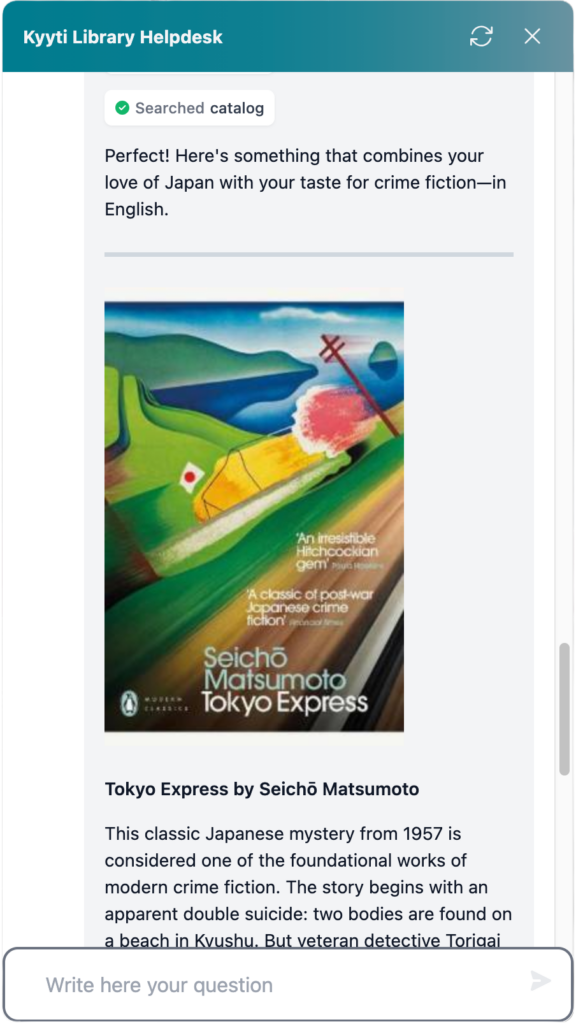
Version 1, 2025 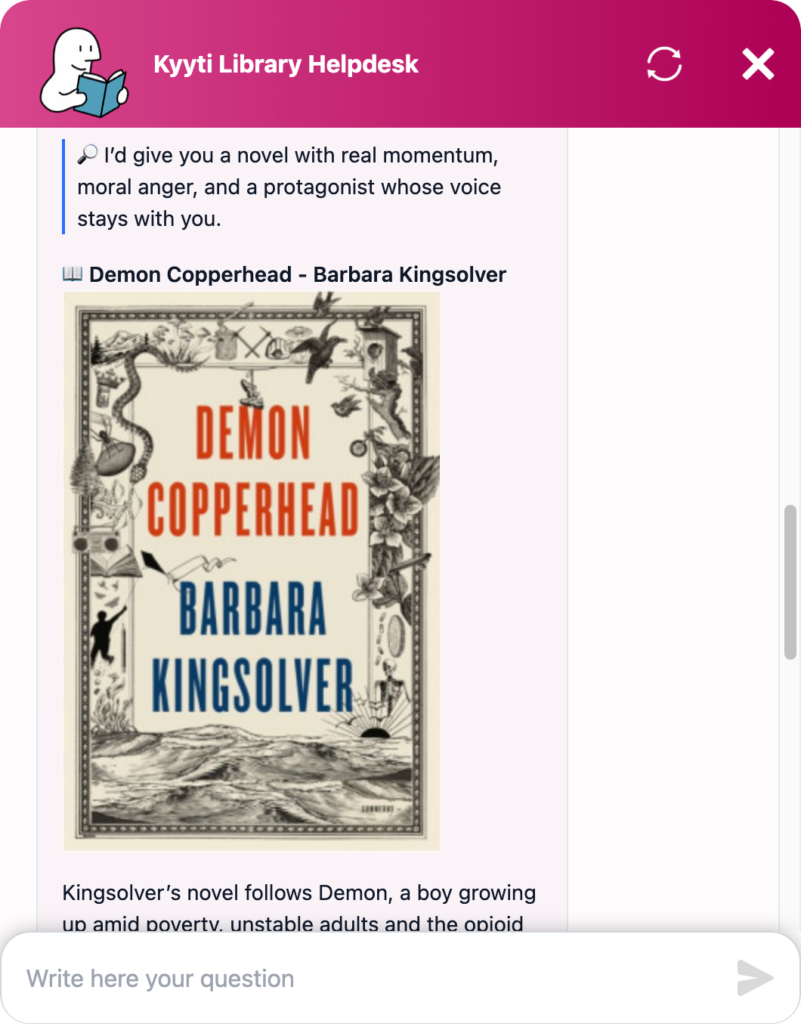
Version 2, September 2026
-
The Library Navigator is live: what we learned building AI book recommendations for Finnish libraries
On March 2nd 2026, the Library Navigator went live across the Kyyti library network: seven municipalities, 18 branches, 165,000 residents in southeastern Finland. Patrons can now receive recommendations for books, films, and music based on their loan history, ask library questions in their own language, and do it all at 2am on a Sunday if that’s when the mood strikes.
This post is about how we got here.
Built with a real library from day one
We developed the Navigator with Kyyti as a partner from the start. The first version, a helpdesk chatbot, launched in March 2025, and Kyyti patrons and librarians told us what worked. Librarians ran hands-on testing sessions and flagged confusing conversation flows or question types we hadn’t anticipated.
That kind of blunt, practical feedback is something internal QA can’t replicate, and it steered most of our decisions during the year. Mikko Vainio, Library Director at Kotka, backed the project from the beginning and helped us with the institutional side as well as practical choices such as the AI’s tone of voice.
“I believe AI will free us up to focus more on meaningful work.”
Mikko Vainio, Library Director at KotkaOver the course of 2025, the helpdesk handled roughly 4,800 patron conversations without requiring staff intervention. That track record gave us, and the library, the confidence to go further.
The recommendation engine and the long tail
The headline feature of the Navigator is the book recommendation system, which took a year of development. When a patron grants permission, the system reads their loan history and identifies patterns of taste rather than genre labels alone. It can tell the difference between “I liked that thriller” and “I want something with the same atmosphere but faster paced”, and that nuance is where it earns its keep.
The real value sits in the long tail: the thousands of titles in a library collection that rarely surface through catalogue browsing or bestseller lists. New releases sell themselves, and the hold queues prove it. The Navigator is good at surfacing an award winner from a decade ago that fits a patron’s taste and happens to be on the shelf right now, no queue. Where a traditional recommendation engine optimises for popularity, the Navigator optimises for fit, so the collection works harder and patrons leave with something they didn’t know they wanted. (Read more on the Navigator product page.)
Pekka Väisänen, a library automation expert with decades of experience in Finnish library systems, sees the technical integration as the significant part:
“What makes this interesting is the depth of the ILS integration. The Navigator reads loan histories and checks real-time availability by connecting directly with Koha and Finna. That kind of deep connection between AI and library infrastructure is genuinely new territory for libraries.”
Pekka Väisänen, library automation expertGDPR took time, and it was worth it
No one had done this before in Finland, or anywhere in the EU. An AI system that processes patron loan histories to make personalised recommendations raises legitimate questions, and we heard every one of them.
The conversations with Data Protection Officers were thorough and sometimes lengthy. We worked through a wide range of scenarios: which data points count as PII, how to support audit trails for security incident detection, conversation logging with a fixed retention window, or no conversation storage at all. For each scenario we found a technical solution that satisfies the requirements, so the system can now be configured to match whichever privacy posture the municipalities’ DPO agrees on.
What patrons are saying
The first days have been encouraging. Many patrons tried the loan history analysis for the first time, and through the feedback form and the thumbs-up/thumbs-down system built into the interface we’re hearing things like:
“Feels like magic.”
“It found themes and patterns in my loan history that I would have never found out myself!”
That second one describes exactly what we designed for. The Navigator reads across a patron’s whole borrowing history and finds connections that aren’t obvious on the surface. A reader who borrows Nordic noir alongside cosy fiction and Japanese culture guides has a layered taste, and the system recommends accordingly instead of treating each genre as a separate bucket.
Always on, in every language
The Navigator works around the clock without staff coverage, which matters for libraries that can’t resource chat support and for residents who are more comfortable in a language other than Finnish.
Patrons can ask in Finnish, English, Swedish, Sámi, Somali, Ukrainian, and dozens of other languages, and get responses in the same language. There is no separate English version to maintain and no language menu to navigate: the Navigator uses the browser language as a starting point and simply follows the conversation from there. For communities with new residents, or for anyone who thinks more clearly in their first language, this removes a real barrier. (Read more on the Navigator product page.)
What’s next
The Navigator is live, but we’re still building. The roadmap is shaped by what we hear from Kyyti’s patrons and staff, and from the libraries that join next.
“Kyyti taught us how to build this properly, with real patrons and real privacy constraints. We’re proud of what came out of that year, and every new partner gets to start from where we finished.”
Andrea Balzarini, Biblioworks.aiIf you’re a library director curious about what this could look like for your network, we’d welcome the conversation.
Book a 30-minute demo and we’ll show you the Navigator working with real library data.
Or try it yourself at kyyti.finna.fi — the Navigator is the chat icon in the bottom right corner.
The Library Navigator is built by Biblioworks.ai, a Finland-based team specialising in AI for public libraries. Read more about the Library Navigator. Read more about the launch on the Kyyti library blog and the Kotka city website.
-
A preview of The Library Navigator
A short post to notify of a semi-public beta testing of The Library Navigator.
You can visit the Finna preview of the Library Navigator at Kyyti Library Network and evaluate the latest release. To begin, click on the helpdesk, bottom right of the webpage.
If you want to test the book suggestions based on the loan history, please send a message to loading…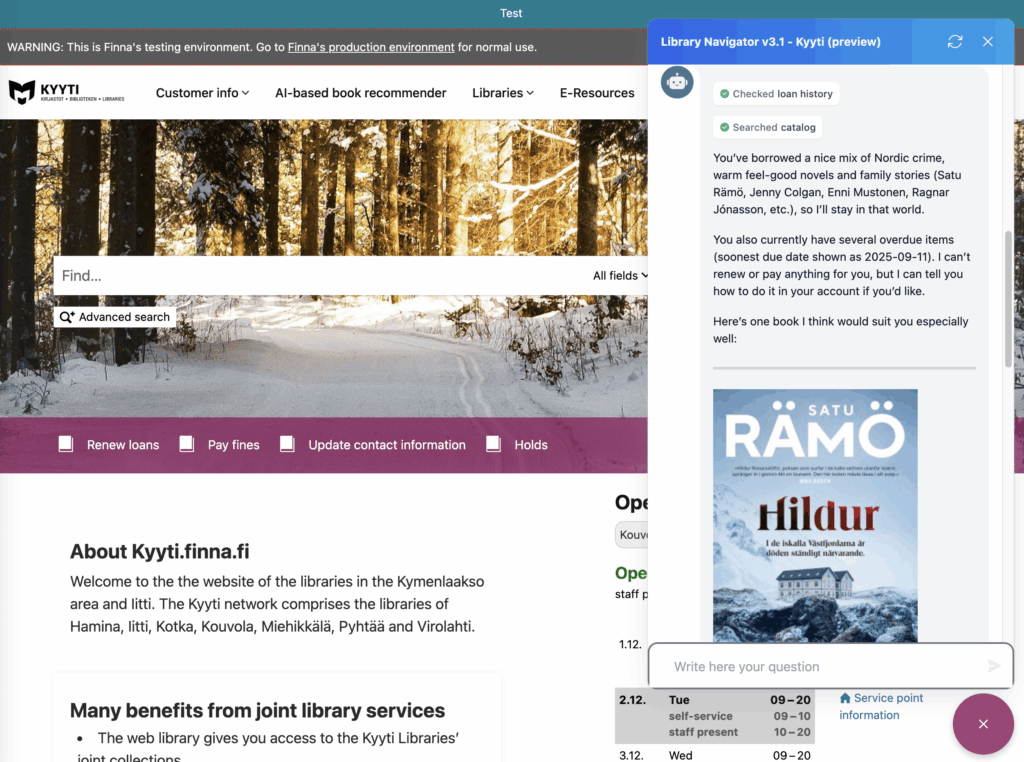
-
Kyyti libraries’ AI experiment to be From Pilot to Permanent: How Kyyti Libraries’ AI Chatbot Won Over Patrons
We are featured again on kirjastot.fi, with good news!
Below is the English translation of the Finnish news post published on Kirjastot.fi on 25 July 2025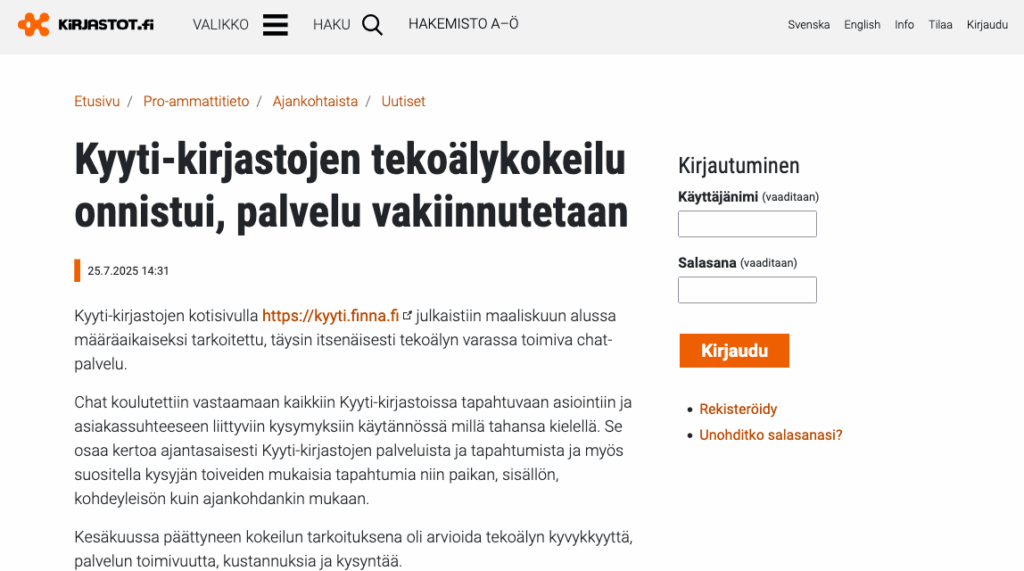
Kyyti Libraries’ AI trial succeeded – the service will be made permanent
At the beginning of March, the Kyyti Libraries’ home page launched a chat service intended for a limited trial period. The service operates entirely autonomously, powered by artificial intelligence.
The chat was trained to answer every question related to transactions and customer relations at Kyyti Libraries—practically in any language. It can provide up-to-date information about Kyyti Libraries’ services and events and can also recommend events tailored to the questioner’s wishes regarding location, content, target audience and timing.
The experiment, which ended in June, aimed to evaluate the AI’s capabilities, the functionality of the service, its costs and the demand for it.
Because of the new and unfamiliar features associated with the pilot, the chat service was not actively marketed. The designers’ imaginations turned out to be wilder than reality: the uncertainties did not materialise. Instead, Kyyti-Chat is reliable, gives correct information and is easy to use. Since the training phase, library staff have not had to intervene in its operation at all. No support requests have been needed, and no user manuals have been requested.
The service keeps itself up to date and aware of everything happening in the libraries.
The service has been embraced naturally. Despite minimal marketing, it is used quite extensively. On average, about thirty conversations are held every day of the week, during which three questions are asked. Each month the chat provides 2,500–3,500 answers. Since publication, it has already delivered roughly 16,000 responses.
Thanks to its positive reception, the quality of its answers and its low overall costs, Kotka City Library has signed an agreement to continue the service. Kotka Library will remain responsible for all development and costs as part of the library’s AI strategy.
The chat service meets the requirements of EU data-protection and AI regulations. Ethical aspects of AI were also considered in its design. The service makes no decisions on anyone’s behalf, does not require user identification and does not use or request personal data. It falls under the EU AI Regulation’s “Minimal-risk” category. The bot is also a kind of local service: the software and its servers are located in Google’s data centre in Hamina.
Further information:
Mikko Vainio, tel. 0 400 935 923
-
Kyyti Helpdesk on Kirjastolehti

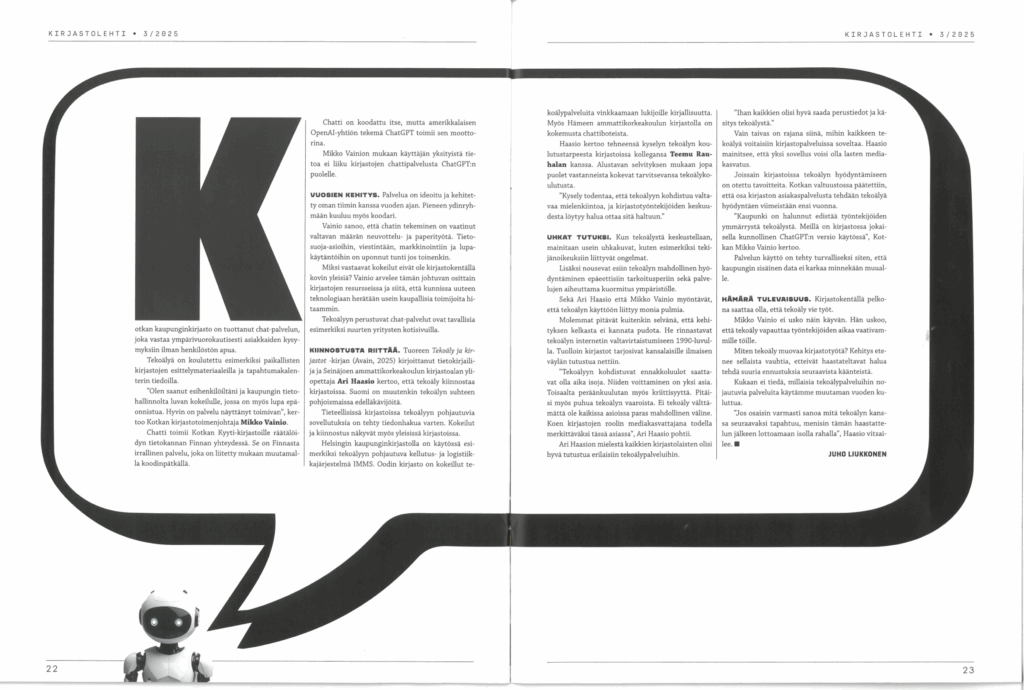
We are featured on the March issue of the printed Finnish magazine Kirjastolehti, the publication of the Finnish Library Association.
In line with the ongoing development of AI-powered services in Finnish public libraries, Kotka City Library is piloting an innovative chatbot service built by Biblioworks.ai on the Kyyti platform. The project explores the use of AI in customer service, allowing library staff to focus on more complex tasks. Below is an AI-generated translation of the article published in Kirjastolehti 3/2025, covering our pilot in detail.
On August 2025 the article was also published online, as Kotkassa testataan kirjaston tekoälybottia.
Courage to Try
Kotka’s libraries are testing a chat service based on artificial intelligence.
The city wants part of the customer service to be handled by AI in the future.
Library professionals say they need more training on the subject.Kotka City Library has developed a chatbot service that answers customer questions around the clock—without the need for staff.
Artificial intelligence has already been trained, for example, with event information from local libraries and presentation materials.
“I’ve been in the same team as the city’s developers for a long time, and this has been a successful collaboration. The service works very well in my opinion”
Mikko VainioThe chatbot is connected to the Kyyti library system’s data interface, Finna.
It is a Finnish solution and has been linked to the system via a few lines of code.Long-Term Development
The service has been designed and developed by a small team over a year.
Vainio says building the chatbot has required a fair amount of instruction crafting and paperwork. It’s been a learning process in data protection, communication, marketing, and legal practices.
Why aren’t similar services more common in libraries?
Vainio suspects it’s partly due to resource constraints and that even larger companies are just starting to integrate AI-based services.
AI-based chatbot services are already offered by major tech companies.
Plenty of Interest
The book Artificial Intelligence and Libraries (Avain, 2025) by Teemu Ruokanen and Seinäjoki University of Applied Sciences lecturer Ari Haasio confirms that AI interest is growing in the library field.
Theoretically, libraries could use AI to make automated recommendations based on user interests.
For example, Hämeenlinna University of Applied Sciences has tested such a chatbot.
Ruokanen notes that many hope AI will help handle routine tasks. Based on his survey with Ruokanen, many respondents feel they need more training on the subject.
Threats Feel Familiar
When discussing AI, fears often arise—like those previously seen with new technologies.
Haasio and Vainio both point out that the current AI boom is not the first. AI-based solutions have been around since the 1990s.
Finnish libraries have long offered digital services for free to the public.
Libraries may use predictive analytics to anticipate customer needs. The goal isn’t to replace librarians, but to support them—especially where time and resources are scarce.
For example, Helsinki’s public transportation system uses similar models. Kotka has used the chatbot to reduce pressure on live services during off-hours.
The chatbot is connected to a secure environment, using a trimmed-down version of ChatGPT.
It’s also been reassuring for the city that the system runs internally, not somewhere vaguely on the internet.
Mikko VainioA Hazy Future
Libraries fear that AI will take over their roles.
Vainio sees it differently:
“I believe AI will free us up to focus more on meaningful work.”
How will libraries change? Development depends heavily on the funding decisions of each municipality.
Who decides what information the AI provides?
In an ideal world, libraries themselves train the AI to reflect their values and knowledge base.
If funding dries up and the city wants to subscribe to a private service later, then we’ll be relying on someone else’s paid model.
🖋 Article credits: Juho Liukkonen
-
Exploring the Citiverse: Biblioworks’ Role at Imagine 2025

Biblioworks is excited to participate in Imagine 2025, a premier event focusing on urban innovation and digital transformation, taking place on May 27–28, 2025, at the Tampere Exhibition and Sports Centre in Finland.
Key Sessions on May 28
- 11:30 AM – Founders’ Stage Andrea Balzarini, a key contributor to Biblioworks, will present a pitch highlighting the organization’s latest initiatives in enhancing libraries and public services through AI-driven solutions.
- 3:30 PM – Innovation Lounge Join us for interactive demos and a fireside chat featuring Mikko Vainio, Director of Kotka City Library. The discussion will explore the integration of AI in library services, emphasizing multilingual support and ethical data practices.
For more information and to register for free, visit the official event website: imagine2025.fi.
We look forward to engaging with fellow innovators and exploring the future of smart, sustainable cities.
-
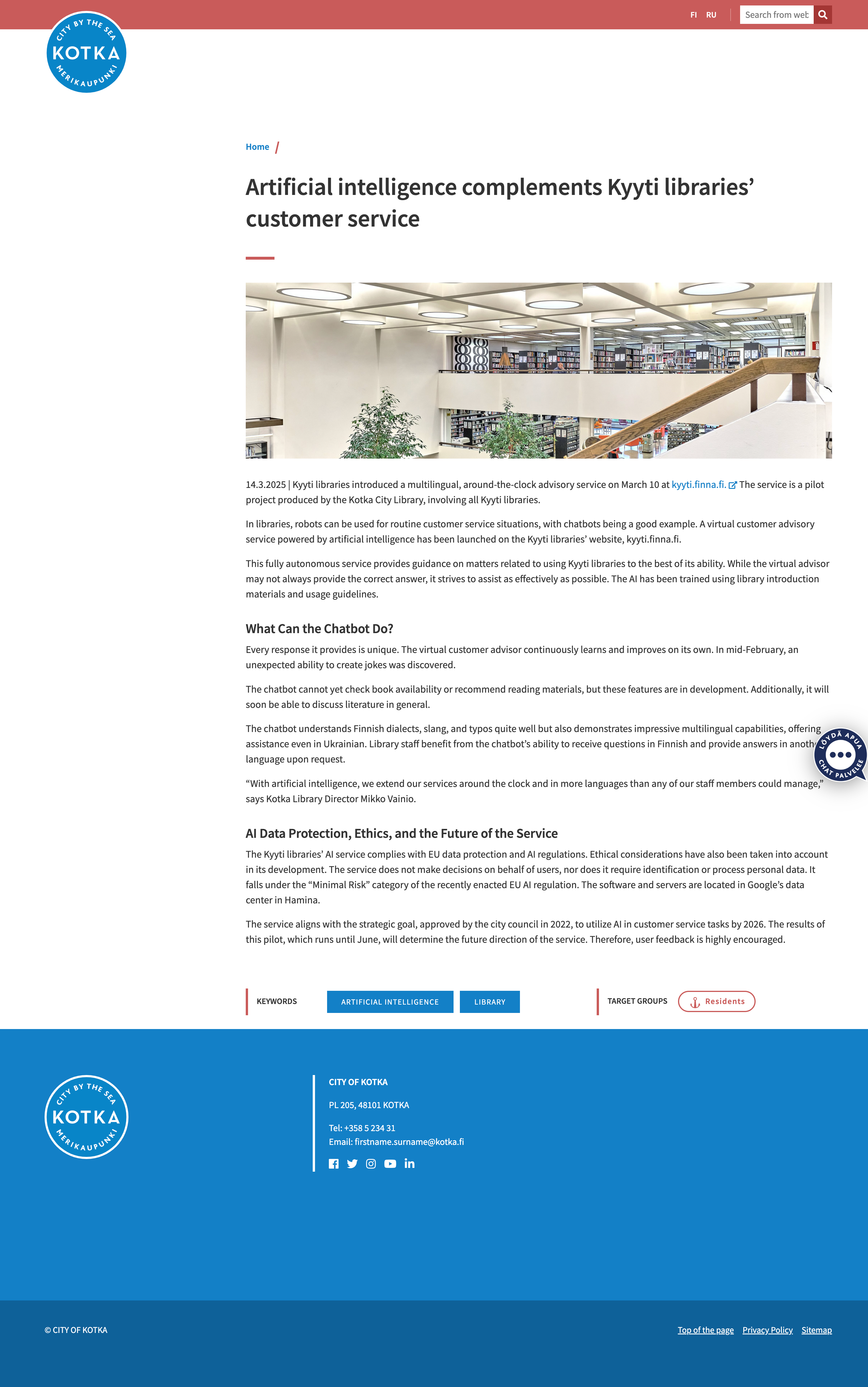
Kyyti Helpdesk on Kotka municipality website
-
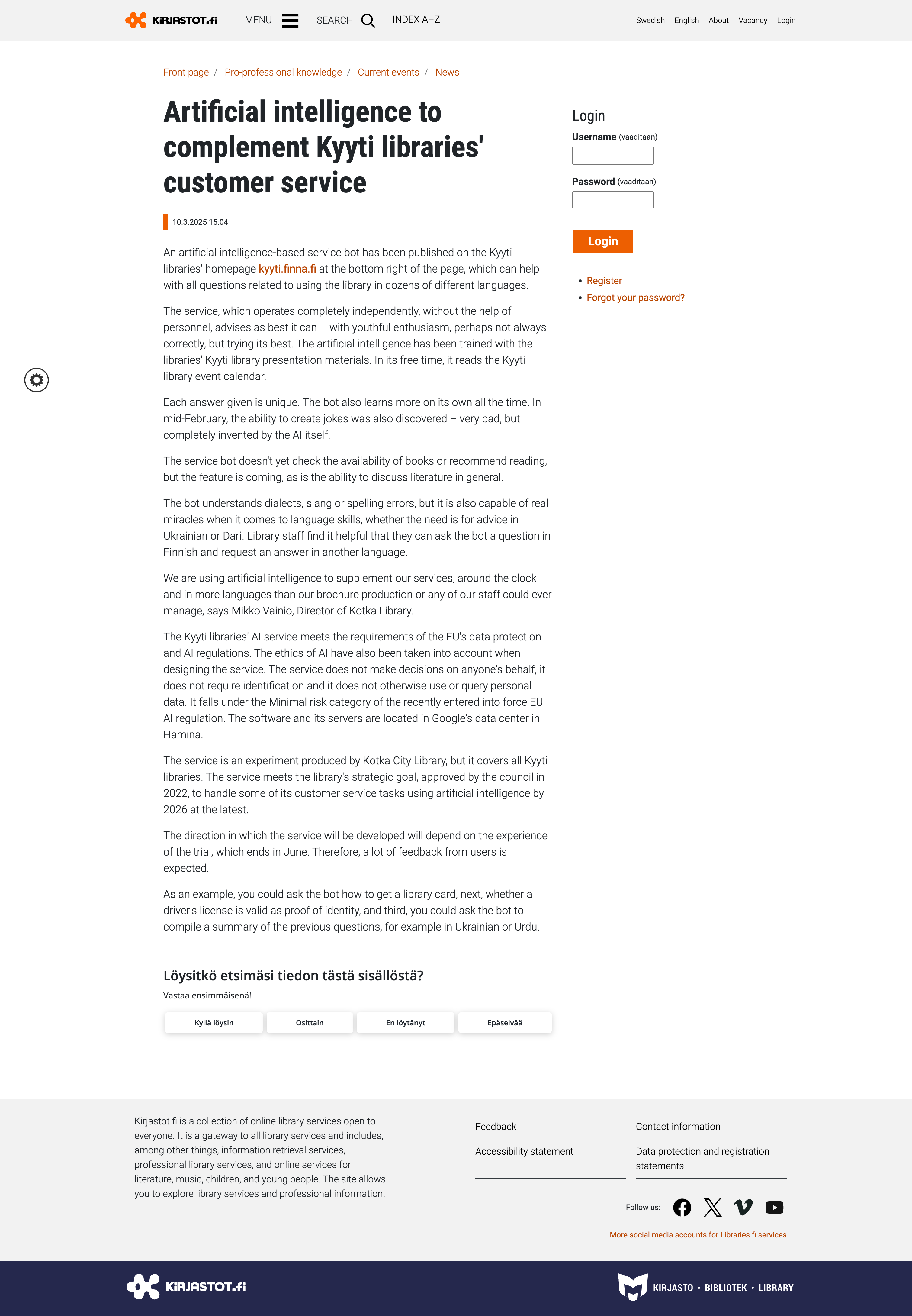
Kyyti Helpdesk on kirjastot.fi
-
Biblioworks.ai Launches AI Customer Service Solution for Kyyti Libraries
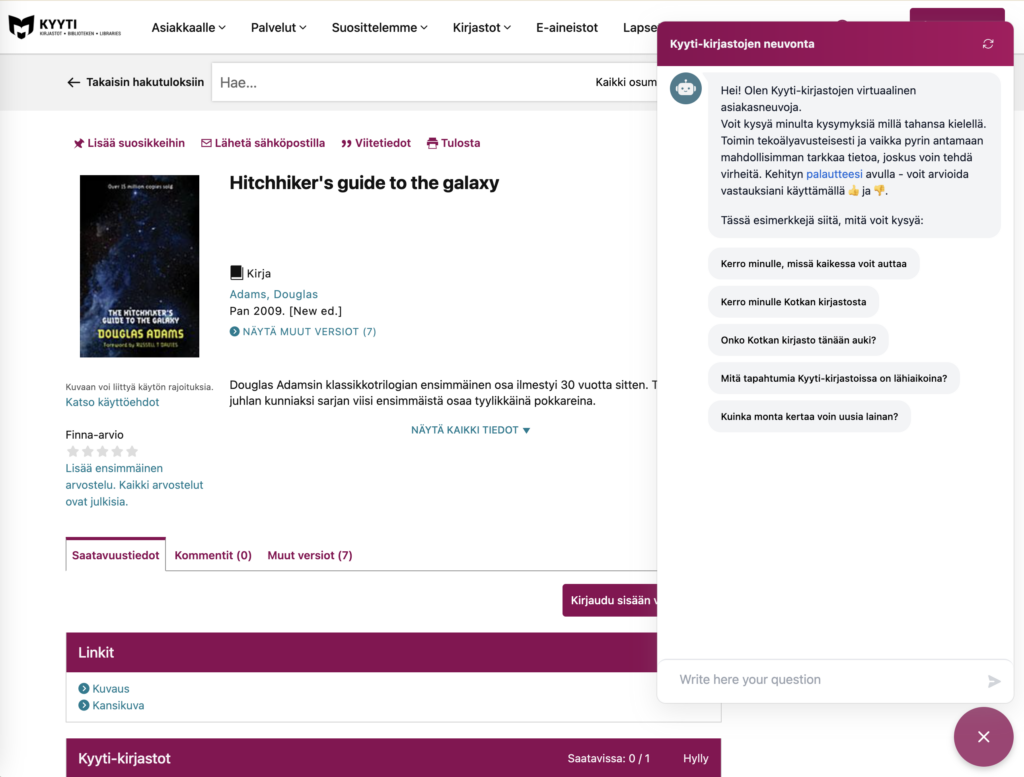
We’re excited to announce the successful deployment of our AI-powered service bot at Kyyti libraries, the consortium of 22 libraries in Southern Finland. The chatbot is now live on the kyyti.finna.fi website, positioned in the bottom right corner to assist users with all library-related inquiries in multiple languages.
As Andrea Balzarini, Co-founder of Biblioworks.ai, puts it: “We’re turning AI expertise into practical, real-world tools that help libraries serve their communities better.”Our Library Helpdesk is a cost effective solution to add customer support to library websites.
Autonomous Support System
Our solution operates completely independently without human intervention. While still in its learning phase (meaning occasional imperfect responses), the bot delivers consistent service by drawing on training materials from Kyyti libraries. To stay current with local events, we’ve programmed it to regularly scan the libraries’ event calendars.
Development Roadmap
Currently, the service provides general information and guidance. Our upcoming Q2 update will add key features like book availability checks, reading recommendations, book discussion tools, and other improvements based on feedback from this initial launch.
Multilingual Functionality
Our natural language processing engine handles dialects, slang, and typing errors with remarkable flexibility. The solution supports dozens of languages, including Ukrainian and Somali, enabling libraries to serve diverse community members. Staff particularly appreciate the translation feature, allowing them to request information in Finnish and receive responses in any supported language.
As Mikko Vainio, Kotka Library Director, notes: “Biblioworks.ai’s solution extends our service availability 24/7 in more languages than our printed materials or staff could ever support.”
Regulatory Compliance
The implementation fully adheres to EU data protection and AI regulations. Our development approach prioritized ethical AI use, creating a system that doesn’t make user decisions, require authentication, or collect personal data. The solution falls under the “Minimal risk” category of the EU AI Act, with infrastructure hosted at Google’s Hamina data center.
Project Background
This deployment represents a collaborative experiment between Biblioworks.ai and Kotka City Library, supporting all Kyyti libraries. The project directly addresses the library’s strategic goal, approved by the city council in 2022, to incorporate AI into customer service operations by 2026.
The pilot runs through June 2025, with further development directions dependent on user feedback. We encourage visitors to test the system with various queries and to explore the multilingual capabilities.
For more information about implementing AI solutions for your library system, contact our team at Biblioworks.ai: loading…
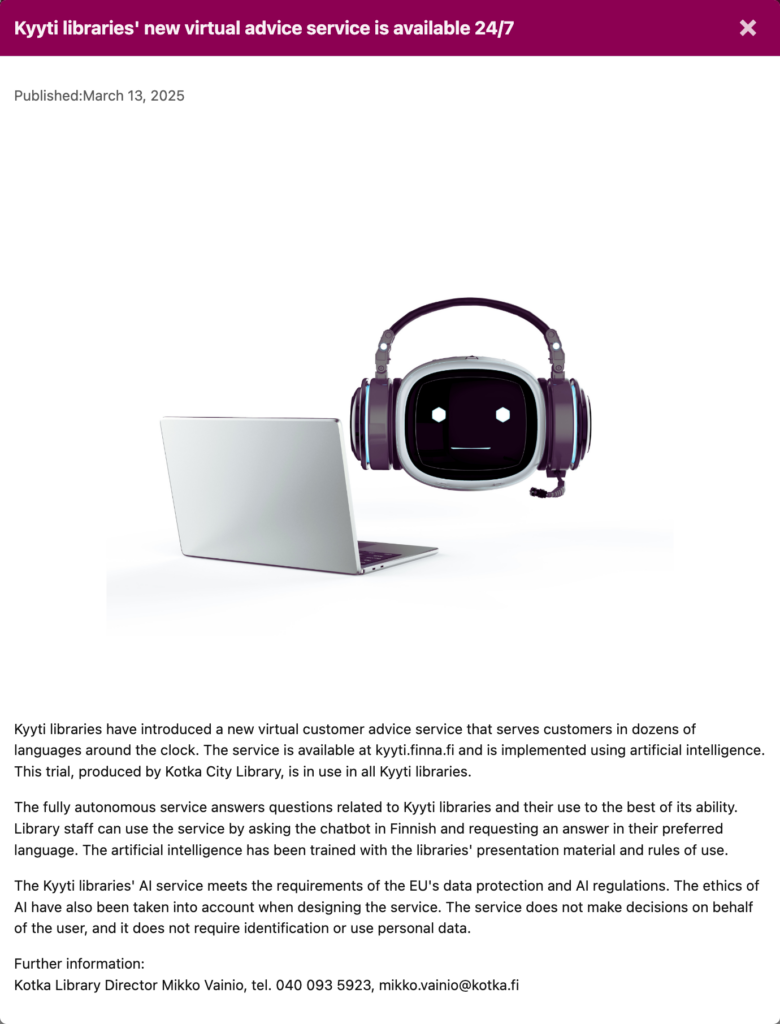
News item inside Kyyti website